
Commercial door security starts with the way your business uses each door
The right commercial lock is not always the strongest lock on the shelf. It is the hardware that fits the door, the traffic level, the fire code requirement, and the people who need approved access.
Business door security usually has to protect:
- Inventory and equipment worth thousands or millions
- Sensitive data and customer information at risk
- Employee safety during and after hours
- Insurance requirements for coverage
- Legal liability if security is inadequate
Commercial door lock options by use case
Mortise locks for heavy-use doors
Mortise locks are built into the door and hold up well on high-traffic commercial entrances when the door and frame are compatible.
Fit: Office buildings, storefronts, high-security areas
Spec to check: ANSI/BHMA Grade 1 for exterior or heavy-use doors
Cylindrical lever locks for interior and office doors
Lever locks are common in offices, restrooms, and interior business spaces because they are easy to operate and available in commercial grades.
Fit: Interior doors, offices, restrooms
Considerations: Choose Grade 1 for exterior use
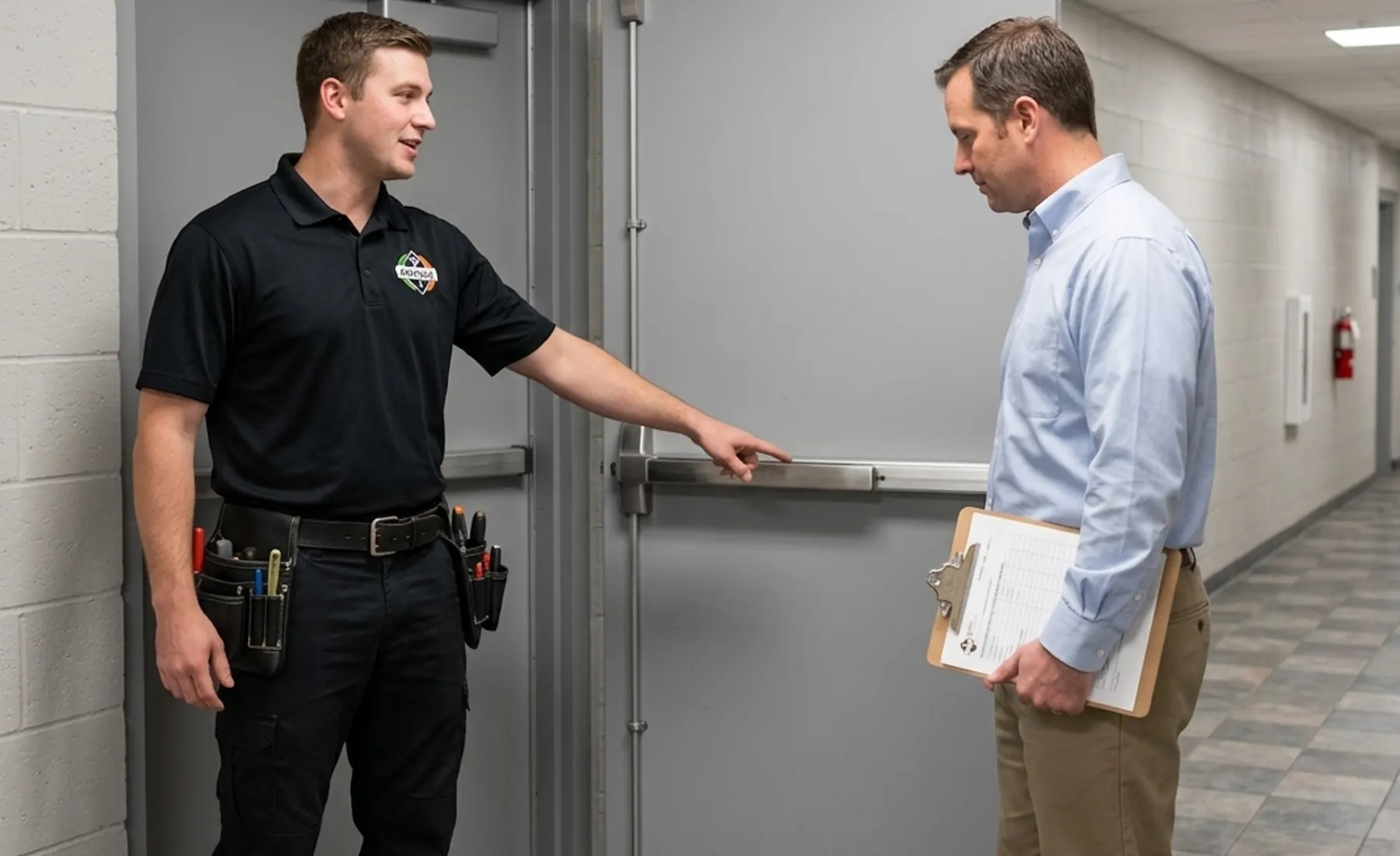
Panic hardware for code-required exits
Code-required for public buildings. Allows emergency exit while preventing entry from outside.
Fit: Emergency exits, assembly areas, schools
Electronic access control for doors with changing users
Access control makes sense when employees, tenants, vendors, or contractors change often and you need credentials that can be added or removed without rekeying every door.
Fit: Multi-tenant buildings, offices needing audit trails, 24-hour facilities
Master key systems reduce key clutter while keeping control
A master key system allows different employees to have different access levels:
- Grand Master: Opens everything (owner/CEO)
- Master: Opens a department (manager)
- Change Key: Opens specific doors only (employees)
This helps businesses:
- One key for management instead of a heavy keyring
- Rekey one area when an employee leaves
- Keep sensitive rooms limited to approved users
Choose hardware by risk, traffic, and code requirement
| Business Type | Recommended Security |
|---|---|
| Retail Store | Mortise lock + security film + alarm |
| Office Suite | Access control + master key system |
| Warehouse | High-security deadbolts + gate locks |
| Restaurant | Keypad locks + master key for managers |
Installation Controls the Result
Commercial doors and frames require precise installation. Poor alignment can weaken even strong hardware.
Delaware fire code context
Delaware follows the International Building Code, which means panic bars (exit devices) are required on doors serving occupancies over 50 people. This affects restaurants, retail stores, churches, event spaces, and office floors. We see businesses get cited during fire marshal inspections because they installed a deadbolt on a door that legally requires panic hardware.
The rule is straightforward: if the room holds more than 50 people, the exit door needs hardware that opens with a single push motion — no keys, no latches, no turning. Panic bars satisfy this. A standard deadbolt does not, even if you leave it unlocked during business hours. The fire marshal wants hardware that cannot be accidentally locked against egress.
What we see businesses get wrong
After years of commercial work in Wilmington, Newark, and the surrounding area, these are the mistakes we fix most often:
Glass storefront doors with the wrong hardware. Wilmington’s Market Street and Trolley Square have plenty of aluminum-frame glass doors. These need narrow-stile mortise locks or Adams Rite-style deadlatches — not the same heavy mortise sets you’d put on a solid wood or steel door. We’ve seen glass doors crack from hardware that’s too heavy or drilled incorrectly.
Warehouse doors with residential-grade locks. Steel warehouse doors on Route 13 and in the Port of Wilmington industrial area take serious abuse — forklifts bumping them, wind load, daily heavy use. A residential Grade 3 deadbolt will fail within months. These doors need Grade 1 commercial deadbolts with reinforced strikes, or heavy-duty padlocks on hasps for roll-up doors.
Ignoring the frame. The best lock in the world fails if the frame is rotted, bent, or has a half-inch gap. We won’t install hardware on a compromised frame without addressing the frame first. It’s a waste of your money otherwise.
Mixing incompatible hardware on a master key system. A business installs one brand on the front door, a different brand on the office, and a third on the stockroom — then wants them all on one key. That’s not how master keying works. The cylinders need to be from the same keyway family. Planning this upfront saves a costly retrofit later.
At Kwikey Locksmith, we:
- Review door use, user groups, and security risk
- Match hardware to your door, budget, and code needs
- Install to manufacturer specifications
- Test all access levels before leaving
- Provide master key charts and documentation
Commercial locksmith service in Delaware and nearby Pennsylvania service areas
Kwikey Locksmith helps businesses plan and install commercial locks, panic hardware, access control, and master key systems. Call (302) 551-2550 to review door count, access goals, hardware condition, and pricing before work is scheduled.